25-06-2026
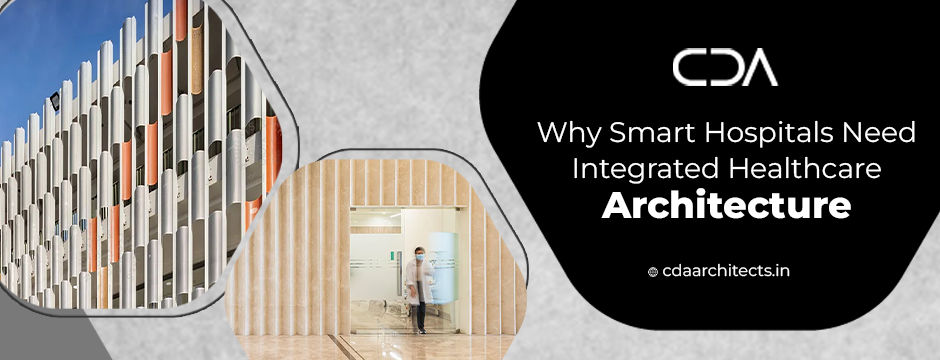
Why Smart Hospitals Need Integrated Healthcare Architecture Ravideep Singh, Sharanya Reddy
Healthcare is changing faster than ever. Patients expect seamless experiences, doctors need instant access to data, and hospital operators are under pressure to improve outcomes while controlling operational costs. In this environment, traditional hospital planning no longer works.
A hospital today is not just a building filled with departments and medical equipment. It is a connected ecosystem powered by data, automation, patient flow intelligence, and digital infrastructure. This is exactly why integrated healthcare architecture has become the backbone of future-ready medical facilities.
At CDA Architects, we believe the next generation of hospitals must combine clinical efficiency, intelligent infrastructure, and patient-centered design into one unified vision. Hospitals that fail to integrate technology into architecture during the planning stage often face workflow bottlenecks, operational inefficiencies, and expensive retrofits later.
For healthcare providers investing in future-ready facilities, integrated architecture is no longer optional. It is the foundation of smarter healthcare delivery.
The Rise of Smart Hospitals in India
India’s healthcare sector is undergoing a massive transformation. Rapid urbanization, increasing patient expectations, telemedicine adoption, and digital health initiatives are changing how hospitals are designed and operated.
Modern healthcare institutions are now investing heavily in:
- Real-time patient monitoring
- Digital diagnostics
- Automated workflows
- Touchless technologies
- AI-driven hospital systems
- Smart energy management
- Connected healthcare ecosystems
This shift has accelerated the demand for advanced healthcare infrastructure design India projects that combine medical excellence with intelligent architecture.
Hospitals can no longer treat technology as an afterthought. Every department, corridor, ICU, operating theatre, and patient room must support connected healthcare operations from day one.
That is where integrated healthcare architecture becomes essential.
What Is Integrated Healthcare Architecture?
Integrated healthcare architecture refers to the strategic planning of healthcare facilities where infrastructure, technology, workflows, engineering systems, and patient experience are designed together as one cohesive framework.
Instead of separating architecture from technology systems, integrated planning ensures both evolve simultaneously.
This approach combines:
- Clinical workflow planning
- IT infrastructure integration
- Medical equipment coordination
- Automation systems
- Building management systems
- Infection control planning
- Data connectivity
- Future scalability
In practical terms, it means the building itself becomes smarter, more efficient, and more responsive to healthcare demands.
Hospitals designed this way support better communication between departments, faster emergency response, reduced downtime, and improved patient care outcomes.
Why Traditional Hospital Design Is No Longer Enough
Many older hospitals were built for a different era. Their layouts focused mainly on space allocation without considering digital infrastructure or evolving patient expectations.
As a result, hospitals often struggle with:
- Fragmented workflows
- Poor interdepartmental coordination
- Technology integration issues
- Inefficient patient movement
- Rising operational costs
- Limited scalability
- Data infrastructure limitations
Retrofitting technology into outdated infrastructure becomes expensive and disruptive.
For example, adding automation systems, digital nurse stations, AI-based monitoring tools, or telemedicine infrastructure after construction can require major structural modifications.
This is why forward-thinking healthcare organizations are prioritizing integrated planning during the early design stage itself.
Smart Hospitals Depend on Connected Infrastructure
The concept of smart hospitals goes beyond advanced equipment. A truly intelligent healthcare facility relies on interconnected systems that work together smoothly.
This includes:
- Electronic health record integration
- IoT-enabled monitoring systems
- Automated HVAC systems
- Smart lighting controls
- Real-time location tracking
- Centralized command centers
- Intelligent patient flow systems
- Telemedicine integration
- Digital diagnostics infrastructure
Without proper architectural planning, these technologies cannot operate efficiently.
Successful smart healthcare buildings are designed around data movement, workflow optimization, and patient experience from the very beginning.
The architecture must support both present-day requirements and future technological advancements.
How Integrated Architecture Improves Patient Experience
Patients today evaluate healthcare facilities differently than they did a decade ago. Convenience, speed, safety, and comfort have become major decision-making factors.
Integrated healthcare architecture directly improves patient experience in several ways.
Faster Patient Movement
Poorly planned hospitals often create confusion and delays. Integrated layouts improve navigation, reduce wait times, and simplify movement between departments.
This leads to smoother patient journeys and lower stress levels.
Better Infection Control
Smart planning enables better zoning, air circulation systems, isolation management, and touchless technologies.
This is especially critical in post-pandemic healthcare environments.
Reduced Waiting Times
When digital systems and workflows are integrated properly, patient registration, diagnostics, consultations, and discharge processes become significantly faster.
Enhanced Comfort
Modern digital healthcare spaces prioritize natural light, acoustic comfort, privacy, and calming interiors alongside advanced healthcare technology.
Patients recover better in environments designed for emotional well-being as well as clinical care.
Operational Efficiency Starts With Design
Hospital profitability and operational efficiency are deeply connected to architecture.
Even small design inefficiencies can lead to:
- Staff fatigue
- Delayed response times
- Equipment movement challenges
- Workflow interruptions
- Increased maintenance costs
Integrated architecture addresses these challenges before construction begins.
For example, proper placement of critical departments can reduce patient transfer time significantly. Smart infrastructure planning can also reduce energy consumption and improve maintenance efficiency.
Hospitals with integrated planning often achieve:
- Better bed utilization
- Faster emergency response
- Improved staff productivity
- Lower operational costs
- Higher patient satisfaction scores
These advantages create long-term financial and operational value.
Technology Integration Must Begin Early
One of the biggest mistakes healthcare developers make is delaying technology planning until later project stages.
Technology should shape architectural decisions from the beginning.
This includes:
- Server room placement
- Data cabling infrastructure
- IoT connectivity
- Smart building systems
- Automation requirements
- Digital imaging infrastructure
- Command center integration
At CDA Architects, early-stage planning for healthcare technology integration ensures hospitals are equipped for both current operational demands and future scalability.
When architecture and technology are planned together, healthcare organizations avoid costly redesigns later.
The Role of Hospital Automation Infrastructure
Automation is transforming modern healthcare facilities.
From patient admission to facility management, automation helps hospitals operate with greater speed and accuracy.
Effective hospital automation infrastructure includes:
- Automated patient tracking
- Smart elevators
- Intelligent nurse call systems
- Energy automation
- Building management systems
- Automated pharmacy systems
- Robotics integration
- Smart inventory management
However, automation only works efficiently when supported by integrated architecture.
For example, robotic transport systems require corridor planning, spatial coordination, and backend infrastructure support. Similarly, centralized monitoring systems need dedicated command spaces and data connectivity.
Hospitals that ignore these requirements during design often face expensive limitations later.
AI Is Reshaping Healthcare Facility Planning
Artificial intelligence is no longer limited to diagnostics. It is actively influencing hospital operations, resource allocation, and patient management.
Modern healthcare facilities increasingly require infrastructure capable of supporting:
- Predictive analytics
- AI-assisted diagnostics
- Smart patient monitoring
- Automated scheduling
- Intelligent workflow optimization
This growing shift has increased the importance of AI-enabled hospital planning during the architectural phase.
Hospitals designed with AI readiness in mind can adapt faster to future healthcare innovations.
This includes stronger digital backbones, scalable server infrastructure, flexible department planning, and intelligent data ecosystems.
Sustainability and Smart Healthcare Design
Sustainability has become a major priority in healthcare construction.
Hospitals consume massive amounts of energy every day. Poor planning increases operational costs and environmental impact.
Integrated architecture helps healthcare facilities become more sustainable through:
- Energy-efficient HVAC systems
- Smart lighting automation
- Water conservation systems
- Renewable energy integration
- Optimized daylight usage
- Waste management planning
- Efficient building orientation
Sustainable design also improves patient comfort and staff productivity.
Future-ready healthcare infrastructure design India projects are increasingly balancing environmental responsibility with operational efficiency.
Why Scalability Matters in Modern Hospitals
Healthcare technology evolves rapidly. Hospitals that cannot adapt become outdated much faster than expected.
Integrated architecture ensures facilities remain scalable for future expansion.
Scalable design considerations include:
- Flexible departmental layouts
- Modular infrastructure systems
- Expandable IT networks
- Future equipment compatibility
- Additional service integration capacity
This flexibility allows hospitals to grow without major disruptions.
For healthcare investors, scalability protects long-term returns and reduces future redevelopment costs.
Data Connectivity Is the New Lifeline
In modern healthcare, data movement is just as important as patient movement.
Hospitals rely on uninterrupted digital communication between:
- Departments
- Diagnostic labs
- ICUs
- Imaging centers
- Emergency units
- Remote specialists
- Cloud systems
Integrated healthcare architecture ensures seamless digital infrastructure throughout the facility.
Poor connectivity planning can lead to delays, communication gaps, and operational inefficiencies.
Well-designed digital healthcare spaces prioritize data accessibility alongside clinical functionality.
The Importance of Human-Centered Design
Technology should improve human experience, not complicate it.
The best smart hospitals combine advanced systems with intuitive, patient-friendly environments.
Human-centered healthcare architecture focuses on:
- Stress reduction
- Simplified navigation
- Staff comfort
- Emotional well-being
- Accessibility
- Privacy
- Safety
Integrated planning ensures technology enhances healthcare delivery without overwhelming users.
This balance is essential for long-term hospital success.
Why Healthcare Developers Need Specialized Architects
Healthcare architecture is one of the most technically demanding sectors in design and construction.
Unlike commercial buildings, hospitals require deep understanding of:
- Clinical workflows
- Medical equipment integration
- Regulatory compliance
- Infection control
- Emergency operations
- Technology infrastructure
- Patient psychology
Working with experienced healthcare architects reduces costly planning mistakes and improves long-term operational outcomes.
At CDA Architects, our approach combines architectural innovation with healthcare intelligence to create facilities that perform efficiently in real-world conditions.
The Competitive Advantage of Smart Hospitals
Healthcare competition in India is intensifying rapidly.
Patients now compare hospitals based on:
- Experience quality
- Technology adoption
- Speed of service
- Safety standards
- Digital convenience
Hospitals with integrated architecture gain a major competitive advantage because they operate more efficiently while delivering better patient experiences.
They also attract:
- Top medical talent
- Premium healthcare partnerships
- Higher patient trust
- Better operational scalability
Smart healthcare infrastructure is becoming a key differentiator in the healthcare market.
The Future of Healthcare Infrastructure in India
India’s healthcare sector is entering a new phase of infrastructure development.
Future hospitals will increasingly depend on:
- Predictive healthcare systems
- AI-supported operations
- Smart monitoring technologies
- Digital patient ecosystems
- Remote healthcare connectivity
- Sustainable infrastructure
This transformation requires architectural strategies that go beyond conventional planning.
The future belongs to healthcare facilities designed around intelligence, adaptability, and integration.
Healthcare organizations investing in smart infrastructure today will be far better positioned for tomorrow’s healthcare demands.
Why CDA Architects Focuses on Integrated Healthcare Design
At CDA Architects, we understand that hospitals are not just construction projects. They are complex operational ecosystems where architecture directly impacts healthcare delivery.
Our integrated design approach combines:
- Clinical functionality
- Smart infrastructure planning
- Digital readiness
- Sustainability
- Scalability
- Patient-centered environments
We collaborate closely with healthcare providers, engineers, technology consultants, and operational teams to create healthcare facilities that remain future-ready for decades.
From conceptual planning to execution, every decision is made with long-term performance in mind.
Conclusion
Smart hospitals are redefining the future of healthcare delivery in India. As medical technology continues to evolve, healthcare facilities must move beyond conventional construction models.
Integrated healthcare architecture creates hospitals that are smarter, more efficient, scalable, and patient-focused.
From intelligent workflows and automation systems to AI readiness and digital infrastructure, every component must work together seamlessly.
Healthcare providers that invest in integrated planning today will build facilities capable of delivering better care, stronger operational performance, and sustainable long-term growth.
For organizations seeking future-ready healthcare infrastructure, the real opportunity lies not just in building hospitals, but in designing connected healthcare ecosystems that are prepared for the next generation of medical care.
FAQs
1. What is integrated healthcare architecture?
Integrated healthcare architecture combines hospital design, technology systems, automation infrastructure, workflows, and patient experience into one unified planning approach.
2. Why are smart hospitals becoming important in India?
Smart hospitals improve operational efficiency, patient experience, safety, and healthcare delivery through advanced digital systems and intelligent infrastructure planning.
3. How does hospital automation infrastructure improve healthcare operations?
Hospital automation infrastructure helps streamline workflows, reduce manual errors, improve patient monitoring, optimize energy use, and increase operational efficiency.
4. What role does AI play in modern hospital planning?
AI supports predictive analytics, smart diagnostics, automated scheduling, patient monitoring, and workflow optimization, making hospitals more responsive and efficient.
5. Why should healthcare projects involve specialized healthcare architects?
Specialized healthcare architects understand clinical workflows, regulatory requirements, infection control, and technology integration, ensuring hospitals function efficiently long term.