02-07-2026
What Are the Key Planning Strategies for Designing a Hospital? Ravideep Singh
Designing a hospital is one of architecture’s most complex planning challenges. Unlike conventional buildings, healthcare facilities operate as high-pressure ecosystems where clinical efficiency, patient safety, infrastructure planning, and human experience must function simultaneously.
Strong hospital design guidelines provide a framework, but successful healthcare architecture goes beyond compliance. Every hospital must respond to its location, patient volumes, medical specialities, operational model, and future expansion needs. Understanding how to design a hospital requires balancing technical precision with long-term adaptability.
Zoning as the Foundation of Hospital Planning
One of the most critical factors to consider in hospital planning is zoning. Poor zoning can increase travel time and create operational inefficiencies across departments.
Hospitals operate through interconnected departments with varying levels of public access, clinical urgency, and operational sensitivity. High-footfall public departments, diagnostics and outpatient departments (OPD design) are typically located in highly accessible zones. Emergency departments require direct ambulance access and immediate proximity to imaging and trauma care.
Critical departments such as ICUs, operating theatres, and recovery units require restricted access and tightly controlled adjacencies. Inpatient departments are often positioned in quieter zones that support healing and privacy.
Why is zoning important in hospital planning?
Zoning ensures that departments with strong functional relationships are located near one another. This improves patient movement, reduces operational stress, and creates better response times during emergencies.
Circulation Must Be Planned Like Infrastructure
In healthcare architecture, circulation determines how efficiently a hospital functions. Patients, doctors, nurses, emergency teams, visitors, housekeeping staff, and biomedical waste services all move through the building in different ways. Without clear segregation, circulation bottlenecks can disrupt operations and compromise infection control.
Successful hospital layout design creates separate circulation systems
Effective hospital planning involves establishing distinct pathways for various groups, including patients, medical personnel, emergency cases, visitors, logistics, and disposal services. This organisation is particularly vital in expansive urban medical centers and multi-story facilities where departments are distributed across multiple floors.
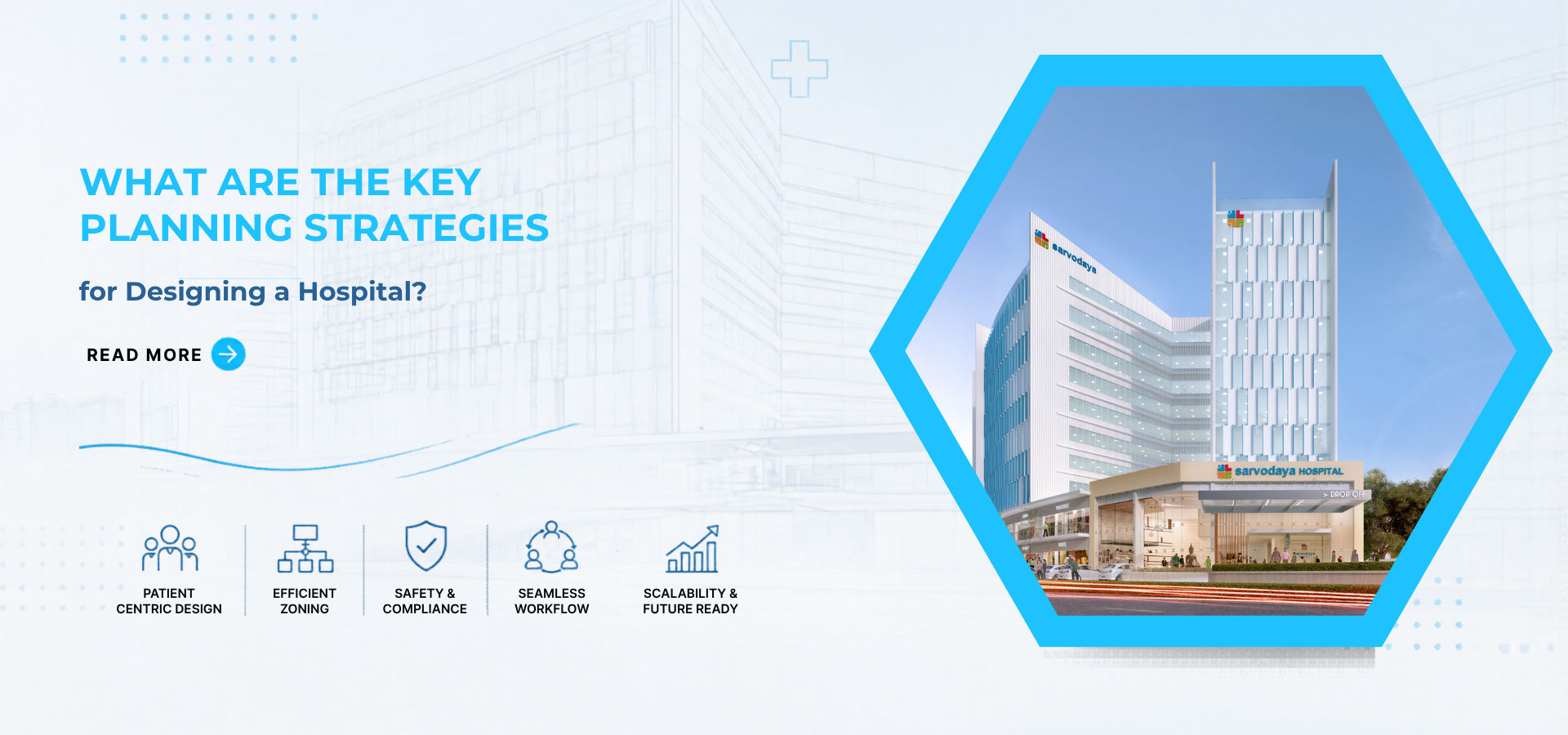
At CDA, these planning principles are often tested within existing urban constraints where healthcare infrastructure must adapt quickly to growing demand. At Sarvodaya Hospital in Greater Noida, an existing mixed-use commercial structure was repurposed into a 300-bed super-speciality hospital within a tight timeline. The original building’s fragmented layout created significant challenges for seamless departmental planning. To resolve this, new corridor connections were introduced between the separate blocks to improve the efficiency of patient, doctor, and staff movement. Public-facing departments such as OPDs were positioned on lower floors, while critical care and surgical departments were strategically located to facilitate faster access to diagnostics and emergency services. Inpatient units were located on upper floors to create quiet recovery environments supported by access to natural light and improved patient comfort. The project aims to showcase how successful hospital planning often hinges on addressing operational challenges through spatial clarity rather than on additional built area.
Clinical Adjacencies Shape Efficiency
One of the biggest challenges in hospital design is understanding which departments need direct adjacency and which can function independently. For example, emergency department design and hospital planning require immediate access to radiology, trauma care, and operating theatres.
What departments should be near each other in a hospital?
Emergency departments should be close to imaging and trauma units. Operating theatres should connect efficiently to ICUs and sterilisation units. OPDs should remain accessible but separated from critical care areas to manage public movement effectively.
How can hospitals be designed for future growth?
Hospitals can support future expansion through modular planning systems, flexible departments, and infrastructure that can accommodate evolving technologies and patient demands over time. While hospital planning guidelines in India provide important benchmarks, architects must interpret these regulations in light of operational realities.
Designing for Patient Experience
Hospitals are high-stress environments. While operational efficiency remains essential, patients' emotional experience cannot be ignored. Natural light, intuitive wayfinding, reduced noise levels, comfortable waiting spaces, and clear movement systems all improve patient experience in hospital design. Healthcare spaces today are increasingly moving beyond clinical sterility toward environments that support emotional well-being.
Sustainability and Operational Performance
Modern hospitals are resource-intensive buildings. Energy consumption, water usage, and waste generation remain significant concerns. This is why sustainable healthcare architecture is becoming central to long-term planning. Passive design strategies, efficient facades, renewable energy systems, and adaptive reuse models are helping healthcare facilities reduce operational costs while improving environmental performance.
Towards Smarter Hospital Planning
Good healthcare design is rarely defined by aesthetics alone. It is shaped by systems thinking, operational efficiency, adaptability, and human-centred planning. As healthcare infrastructure continues to evolve, architects must move beyond static planning models toward more responsive systems that balance performance and patient care.